If you’re shopping for PFOA-free nonstick cookware, you’ve probably seen those two little words everywhere:
PFOA-free.
It sounds reassuring. And it is useful information — but it doesn’t tell you everything you probably want to know.
But first, why are we trying to avoid PFOA and PFAS?
PFAS are a group of man-made chemicals often called “forever chemicals” because they are extremely difficult to break down and can persist in the environment and our bodies.
Some PFAS have been linked to serious health effects, including certain cancers, hormone disruption and effects on the immune system.
That’s why many people choose PFAS-free cookware: if you can avoid unnecessary exposure to these persistent chemicals, why wouldn’t you?
Now here’s where cookware labels get confusing.
A pan can be PFOA-free and still use PTFE for its non-stick coating. And PTFE belongs to the much larger PFAS family.
So if you’re trying to avoid PFAS-based non-stick coatings, simply finding a pan labelled “PFOA-free” isn’t quite enough.
Don’t worry. You don’t need a chemistry degree to work this out.
You just need to know which words to look for and which ones aren’t telling you very much.
PFOA-Free vs PTFE-Free vs PFAS-Free: What’s the Difference?
This is where cookware labels can make your head spin.
Here’s the simple version.
PFAS is the name for a very large family of chemicals.
PFOA is one specific chemical within that family.
PTFE is a fluoropolymer used to give traditional non-stick cookware its slippery surface. PTFE is also part of the broader PFAS family.
So these terms aren’t interchangeable.
A manufacturer can remove PFOA and truthfully say:
“PFOA-free.”
But the pan can still have a PTFE-based coating.
That’s the bit many of us don’t realise when we first start looking into cookware.
I’ve explained the differences between these three labels in much more detail here:
PFOA-Free vs PTFE-Free vs PFAS-Free: What’s the Difference?
For this article, the takeaway is simply:
PFOA-free does not automatically mean PTFE-free or PFAS-free.
Is PFOA-Free Nonstick Cookware Safe?
This is probably the question you’re really trying to answer.
And unfortunately, “PFOA-free” on its own isn’t enough information to answer it.
You still need to know what the non-stick coating is made from.
A PFOA-free pan might use PTFE.
Another might use a PFAS-free ceramic coating.
Another might have no synthetic non-stick coating at all.
Those are three very different cooking surfaces.
The U.S. FDA says certain PFAS-based substances are authorised for use in non-stick cookware coatings and notes that, for these highly polymerised coatings, studies have shown negligible migration to food under intended use.
So this isn’t about telling you that every traditional non-stick pan is automatically dangerous.
It’s about being clear about what you’re choosing.
If your goal is specifically to avoid PFAS-based non-stick coatings, then I’d look beyond “PFOA-free” and check for a PFAS-free and PTFE-free statement.
What Should You Look For in PFOA-Free Nonstick Cookware?
If you’re shopping for a new pan because you want the convenience of non-stick cooking without a PTFE/PFAS coating, I’d work through these checks.
1. Look for a Clear PFAS-Free AND PTFE-Free
If a pan only says:
PFOA-free
keep looking.
Instead, see if the manufacturer clearly says the non-stick coating or cooking surface is PFAS-free and PTFE-free.
If you’re searching for PFOA and PTFE free nonstick cookware, this is the combination of claims you’re really looking for.
And if the manufacturer explains what the coating is made from, even better.
For example, “ceramic coating made without PFAS” tells you considerably more than a front-of-box claim that simply says “PFOA-free.”
2. Find Out What the Coating Actually Is
This sounds obvious, but it’s surprisingly easy to miss.
A pan might be described as:
- ceramic
- stone
- granite
- mineral
- natural
- healthy
- eco-friendly
None of those words, by themselves, tell you enough about the chemistry of the cooking surface.
“Ceramic” is a material description, not automatically a guarantee that a particular pan is PFAS-free.
So if you’re considering PTFE and PFOA free nonstick cookware, go one step further.
Find the manufacturer’s actual statement about the coating.
What is it made from?
Is it PTFE-free?
Is it PFAS-free?
Does the manufacturer provide supporting information?
That’s where the useful information is hiding.
What Does a Good Manufacturer Claim Actually Look Like?
This is where things get much easier.
There are manufacturers that clearly spell out what they say their cookware coating does and doesn’t contain.
Here are a few examples from different markets.
| Brand | Market | What the manufacturer currently states |
|---|---|---|
| Neoflam | Australia | Its Ecolon ceramic coating is stated to be PFAS-free, PTFE-free and PFOA-free, as well as lead- and cadmium-free. |
| Baccarat | Australia | Selected ceramic ranges, including Triton, are stated to be PFAS-free, PTFE-free and PFOA-free. |
| HexClad | UK | Its TerraBond ceramic non-stick is stated to be PFAS-free, and the company publishes third-party laboratory results showing PTFE, PFOA and other tested PFAS compounds as non-detectable. |
| Le Creuset | UK | Its Essential Non-Stick Ceramic range is stated to use a ceramic coating made without PFAS. |
| Caraway | International/US | Its ceramic-coated cookware is stated to be made without PFAS, PTFE and PFOA, and the company says its cookware is third-party tested. https://www.carawayhome.com/third-party-testing |
| GreenPan | International/US | Thermolon ceramic non-stick is free of PFAS, including PTFE and PFOA; GreenPan says its cookware and coating undergo independent testing by accredited third-party labs. https://www.greenpan.us/pages/safety-of-our-product? |
There are two things I want you to notice here.
These companies aren’t all using exactly the same wording.
And that’s okay.
What matters is that they’re giving you specific information about the coating rather than leaving you to guess what “healthy non-stick” means.
Also, these are manufacturer claims, not my independent laboratory testing. That’s an important distinction.
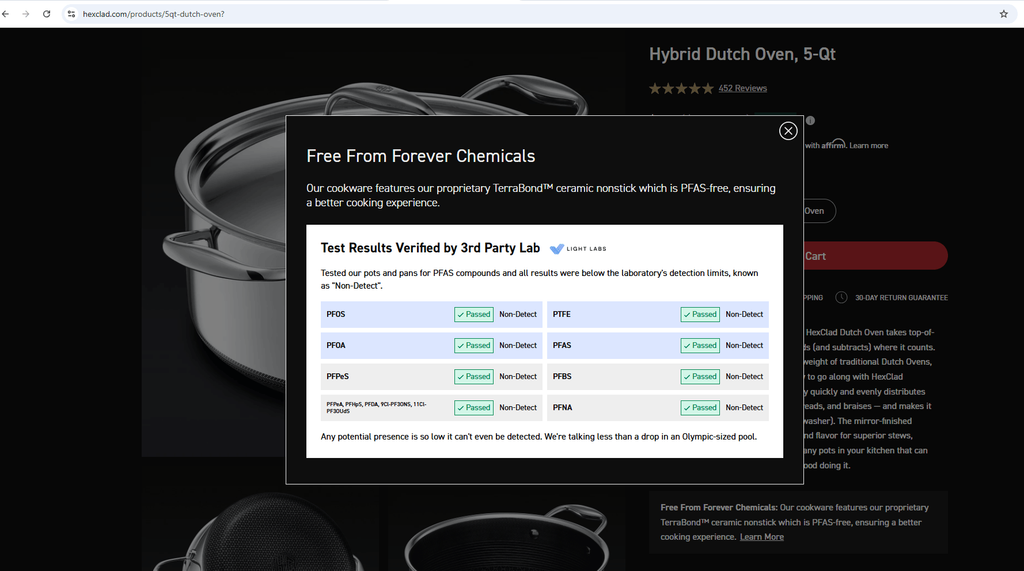
Where a company publishes third-party testing, that’s useful additional evidence but I’d still read what was actually tested rather than simply trusting a “third-party tested” badge.
What About PFAS-Free Ceramic Non-Stick?
If you want something that feels most like traditional non-stick cookware, PFAS-free ceramic-coated cookware is probably the closest alternative.
Ceramic-style non-stick coatings are generally made without the fluoropolymer coating used in traditional PTFE cookware.
But there’s an important catch:
Not every pan described as “ceramic” should automatically be assumed to be PFAS-free.
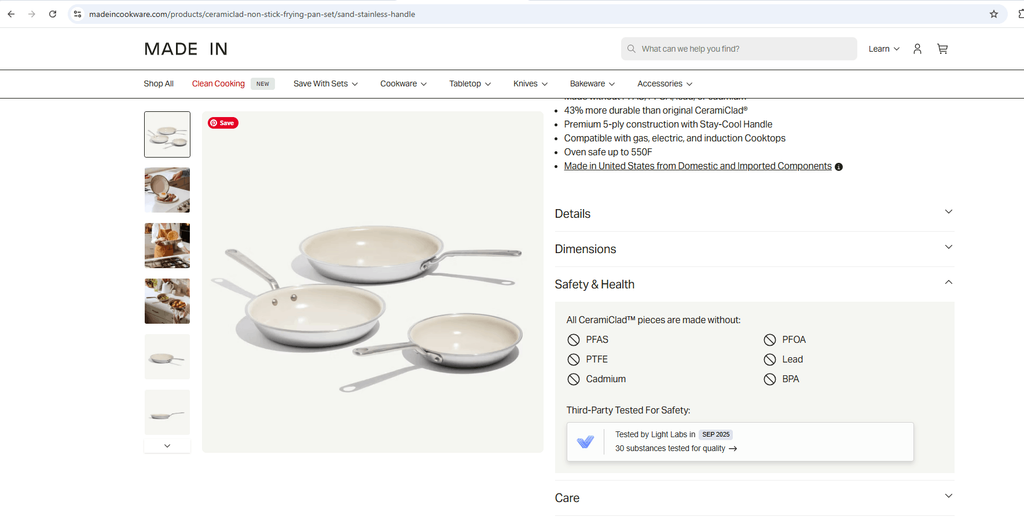
Look for the manufacturer’s specific PFAS-free and PTFE-free statement like this one from MadeIn.
And remember that ceramic non-stick has a trade-off.
The coating can lose some of its slippery performance over time, particularly with frequent high-heat cooking or rough treatment.
So don’t think of ceramic as:
“PTFE, but exactly the same.”
It isn’t.
Think of it as a different type of coated cookware with its own strengths and weaknesses.
For many people, that’s a perfectly reasonable trade-off.
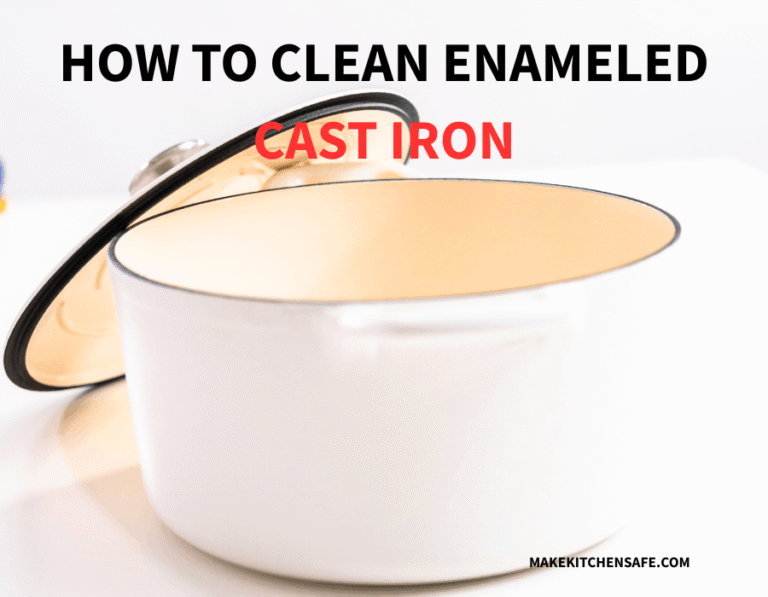
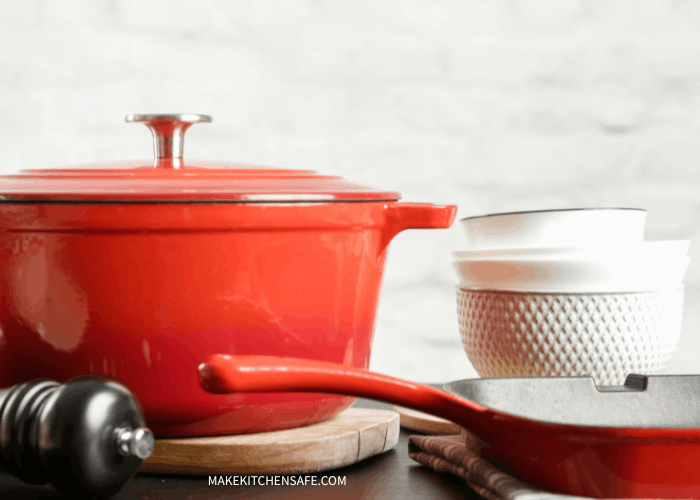
What About Enamelled Cast Iron?
Enamelled cast iron is worth mentioning but I wouldn’t call it a direct replacement for a traditional non-stick frying pan.
The cooking surface is made from vitreous enamel rather than a PTFE-based non-stick coating.
It’s excellent for:
- soups
- stews
- braises
- sauces
- roasting
- oven cooking
But it isn’t going to give you the same slippery surface you get from a brand-new non-stick frying pan.
So I’d think of enamelled cast iron as:
a PFAS-free cooking surface
rather than:
a true non-stick substitute.
That’s an important distinction because you don’t want to spend a lot of money on an enamelled pan expecting your morning eggs to slide around like they’re on ice.
What About Cast Iron and Carbon Steel?
Here’s another option that doesn’t get enough attention when we’re talking about non-stick cookware.
You don’t necessarily need a manufactured non-stick coating to get a naturally slick cooking surface.
Seasoned cast iron and carbon steel develop a seasoned surface as cooking oils polymerize onto the metal.
With the right heat and a little practice, both can become surprisingly non-stick.
They’re not maintenance-free.
And they have a learning curve.
But because they don’t rely on a fluoropolymer non-stick coating, they don’t raise the same PFAS question as conventional PTFE-coated cookware.
Learn how to cook with Cast-Iron Cookware? Once you do, you’ll fall in love with this just like me.
If you’re willing to learn a slightly different way of cooking, this can be a simple way to move away from synthetic non-stick coatings altogether.
For a broader look at cookware materials including stainless steel, cast iron, carbon steel, ceramic and other options see What Is the Safest Cookware for Your Health? Honest Answer.
How to Check a Cookware Claim Before You Buy
This is the part I’d bookmark.
Because once you know what to look for, shopping for PFOA-free nonstick cookware becomes much less confusing.
Step 1: Don’t Stop at “PFOA-Free”
If avoiding PFAS is your goal, look for a clear PFAS-free and PTFE-free statement about the cooking surface or coating.
PFOA-free on its own doesn’t answer that question.
Step 2: Find the Actual Coating Material
If the website doesn’t tell you what the non-stick coating is made from, that’s worth noticing.
“Advanced coating” isn’t an answer.
Neither is “healthy non-stick.”
I’d rather see a manufacturer clearly name the coating and explain what it does.
Step 3: Check the Manufacturer’s Disclosures
Look for clear information from the manufacturer about PFAS, PTFE and PFOA, like the examples in the table above.
The more specific the information, the better.
Step 4: Look for Independent Testing
Third-party testing can be helpful, particularly when a manufacturer publishes actual test results rather than simply saying “third-party tested.”
A testing claim sounds impressive.
Actual testing information is much more useful.
Step 5: Ask the Manufacturer
If you still can’t find a straight answer, ask.
Something as simple as:
“Is the cooking surface PTFE-free and PFAS-free? Can you provide documentation or testing that supports this claim?”
A transparent manufacturer should be able to explain what its coating is and what its PFAS-free claim means.
What If You Already Own a Non-Stick Pan?
I wouldn’t throw out every non-stick pan in your kitchen simply because you discovered the word PFOA.
If you’re trying to reduce PFAS exposure, start by understanding what you actually have.
If you already own a pan and aren’t sure whether it contains PFAS, use How to Tell If Your Pans Have PFAS – 5 Signs to Check Right Now.
And if you’re trying to work out which cookware you should replace first without blowing your entire kitchen budget, read [The Best Affordable Non-Toxic Cookware: What to Buy First and What Can Wait?]coming soon
That’s a much more sensible approach than feeling like you need to replace everything tomorrow.
So, What’s the Best PFOA-Free Nonstick Cookware?
If you’re searching for the best PFOA free nonstick cookware, don’t let PFOA-free be the end of your research.
Ask one more question:
“What is the non-stick coating actually made from?”
If the manufacturer clearly states that the non-stick coating is PFAS-free and PTFE-free, that’s a much more useful starting point than PFOA-free alone.
If you don’t need a slippery manufactured coating, seasoned cast iron or carbon steel or stainless steel remove the coating question altogether.
And if you’re looking for a versatile PFAS-free cooking surface rather than true non-stick performance, enamelled cast iron is another option.
You don’t need to memorise a dozen chemical names.
Just remember this:
PFOA-free tells you about PFOA. It doesn’t tell you everything about the coating.
So next time you’re standing in front of a wall of frying pans, don’t just look for the biggest “PFOA-FREE” label.
Turn the box around. Find out what’s actually on the pan.
That’s where the useful information usually is.
What to Read Next
Want to understand these three labels properly?
→ PFOA-Free vs PTFE-Free vs PFAS-Free: What’s the Difference?
Already own a non-stick pan and wondering whether it contains PFAS?
→ How to Tell If Your Pans Have PFAS – 5 Signs to Check Right Now
Want to compare cookware materials more broadly?
→ What Is the Safest Cookware for Your Health? Honest Answer
Interested in why I moved away from traditional non-stick?
→ Why I Replaced My Non-Stick Cookware After Learning About PFAS