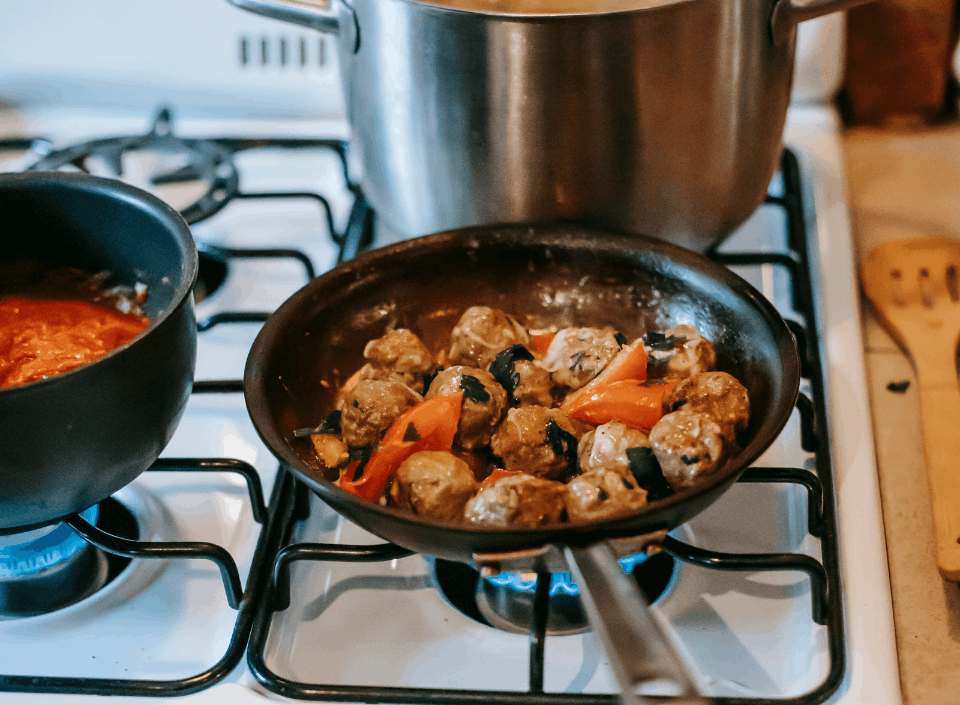
If you’ve ever wondered how to tell if your pans have PFAS, you’re not alone.
Not sure what PFAS is? You’re not alone.
PFAS are a group of man-made chemicals used in many traditional non-stick pans to create the slippery coating. They’re often called “forever chemicals” because they don’t break down easily.
Most of us bought our cookware years ago without thinking twice about what the non-stick coating was actually made from. And with labels saying things like PFOA-free, PTFE-free, and PFAS-free, it’s easy to assume they’re all the same.
They’re not.
Luckily, you don’t need to send your cookware to a lab to figure out whether it could be a PFAS risk because there are a few simple things you can check right now in your own kitchen.
Let’s go through them.
Check why I threw away all my non-stick cookware and what am i using now.
1. Is It a Non-Stick Pan?
This is the first thing to look at.
If food slides around easily with very little oil, your pan probably has a non-stick coating. The important question is what kind of coating it has.
There are two common types:
PTFE (Traditional Non-Stick)
This is the coating most people think of as Teflon®. PTFE belongs to the PFAS family of chemicals and is found on many traditional non-stick pans.
It’s usually smooth, dark grey or black, and feels very slippery when new.
Ceramic Non-Stick
Ceramic cookware uses a mineral-based coating rather than PTFE. When it’s made properly, it’s generally considered PFAS-free.
These pans often have a cream, white, or light-coloured cooking surface with a more matte finish.
How to Tell If Your Pans Have PFAS
Search your pan’s brand and model online along with phrases like:
- “coating type”
- “PTFE”
- “PFAS”
If the product only says “PFOA-free”, that’s a warning sign, not a reassurance.
Many people think PFOA-free means PFAS-free, but it doesn’t. In many cases, it simply means the pan still uses a PTFE coating without PFOA.
If you can’t find clear information, it’s safest to assume the pan contains PTFE until the manufacturer says otherwise.
2. Is the Coating Scratched, Chipped or Peeling?
Take a close look at the cooking surface.
If you notice:
- scratches
- chips
- peeling
- flaking
- bubbling
- patches where the coating has worn away
it’s time to replace the pan.
Research from Flinders University found that even a single scratch on a PTFE-coated pan can release thousands of tiny plastic particles. As the coating breaks down, that number increases dramatically.
If the coating is damaged, continuing to cook with it simply isn’t worth the risk.
Ceramic coatings can also wear out over time, but they don’t raise the same PFAS concerns as damaged PTFE coatings.
3. Do You Often Cook on High Heat?
Even if your pan looks perfect, the way you use it matters.
PTFE coatings start breaking down when they get too hot. This can happen surprisingly quickly, especially if you heat an empty pan.
Think about your cooking habits.
Do you:
- preheat your pan before adding oil?
- cook on high heat?
- sear meat in a non-stick pan?
- leave an empty pan heating on the stove?
- use it under the grill or broiler?
If you answered yes to any of these, your non-stick cookware may be exposed to temperatures it wasn’t designed for.
As a simple rule, keep PTFE pans on low to medium heat and never heat them empty.
4. How Old Is Your Pan?
Age matters more than most people realise.
PFOA was largely phased out around 2015, so older cookware may contain both PFOA and PTFE.
Even newer PTFE coatings gradually wear down with everyday cooking. The damage isn’t always obvious, but years of heating, washing and using utensils slowly break down the surface.
If your non-stick pan is more than five to seven years old and gets regular use, it’s worth asking whether it’s time for a replacement.
5. Does the Label Only Say “PFOA-Free”?
This is one of the easiest ways to tell if your pans have PFAS.
If the packaging proudly says:
PFOA-Free
…but says nothing about PTFE-free or PFAS-free, the pan almost certainly still has a PTFE coating.
Check what’s the difference of PFOA-Free vs PTFE-Free vs PFAS-Free ?
Manufacturers know that shoppers are looking for PFAS-free cookware. If their product truly doesn’t contain PFAS, they’ll usually say so because it’s a strong selling point.
So when you only see PFOA-free, it’s often what’s missing from the label that tells the real story.
What Should You Do If Your Pan Has PFAS?
Finding out your cookware contains PFAS doesn’t mean you need to throw everything out tomorrow.
Instead, replace your cookware one by one.
Replace immediately if:
- the coating is scratched
- it’s peeling or flaking
- it’s badly damaged
Replace next:
Your everyday frying pan.
This is the piece of cookware you use most often, so swapping it first makes the biggest difference.
While You’re Replacing Cookware
To reduce wear on PTFE pans:
- use medium heat or lower
- never preheat an empty pan
- use wooden or silicone utensils
- avoid metal utensils
- make sure your kitchen is well ventilated
Quick Kitchen Checklist
If you’re wondering how to tell if your pans have PFAS, ask yourself these five questions:
- Is it a non-stick pan?
- Does it only say PFOA-free?
- Is the coating scratched or peeling?
- Is it more than 5–7 years old?
- Do you regularly cook on high heat?
If you answered yes to one or more of these, that pan should be at the top of your replacement list.
Check this post to avoid these 8 common mistakes when switching from Non-stick cookware.
Bottom Line
Learning how to tell if your pans have PFAS doesn’t have to be complicated.
By checking the coating, the label, its condition, its age, and how you use it, you can quickly work out which pans are worth keeping and which ones are ready to retire.
You don’t have to replace everything overnight. Start with the cookware you use every day, especially if it’s scratched or only labelled PFOA-free. Small changes over time can make your kitchen a safer place to cook.
Ready to know what to replace them with? Read this next: [PFOA-free cookware — complete guide to what it means and what to buy]
Sources
- Flinders University — 2022 study — single scratch on PTFE pan releases ~9,100 microplastic particles; up to 2.3 million including nanoplastics Referenced via: https://www.natureworldnews.com/articles/54089/20221110/scratched-teflon-non-stick-pan-releases-9-100-microplastic-particles.htm
- ScienceDirect — 2024 peer-reviewed study — PTFE coatings emit gaseous PFAS when heated; degrade above 260°C https://www.sciencedirect.com/science/article/pii/S0048969724027232
- Consumer Reports — recommends replacing pre-2013 non-stick cookware; testing found PFOA in “PFOA-free” labelled pan https://www.consumerreports.org/toxic-chemicals-substances/you-cant-always-trust-claims-on-non-toxic-cookware-a4849321487/
- US EPA — PFAS health risks, non-stick cookware as confirmed exposure source https://www.epa.gov/pfas/our-current-understanding-human-health-and-environmental-risks-pfas
- NIH — NIEHS — PFAS health effects https://www.niehs.nih.gov/health/topics/agents/pfc
- California AB1200 — bans single PFAS-free claims on cookware packaging https://leginfo.legislature.ca.gov/faces/billNavClient.xhtml?bill_id=202120220AB1200

This is such helpful information! I never realized how difficult it could be to tell whether cookware contains PFAS just by looking at it. It really shows why reading labels, researching materials, and knowing what questions to ask before purchasing cookware is so important. Definitely something worth paying more attention to in the kitchen!
This is so helpful! I’ve always wondered if ceramic coating was safe and I have been staying away from it. Now that I’ve read this I will be looking into what my ceramic coating is considered to see if I need to replace it!
[…] But if you’re still using non-stick cookware and wondering whether your existing pans contain PFAS, there are a few things you can check before deciding what to do with them. How to Tell If Your Pans Have PFAS – 5 Signs to Check Right Now […]