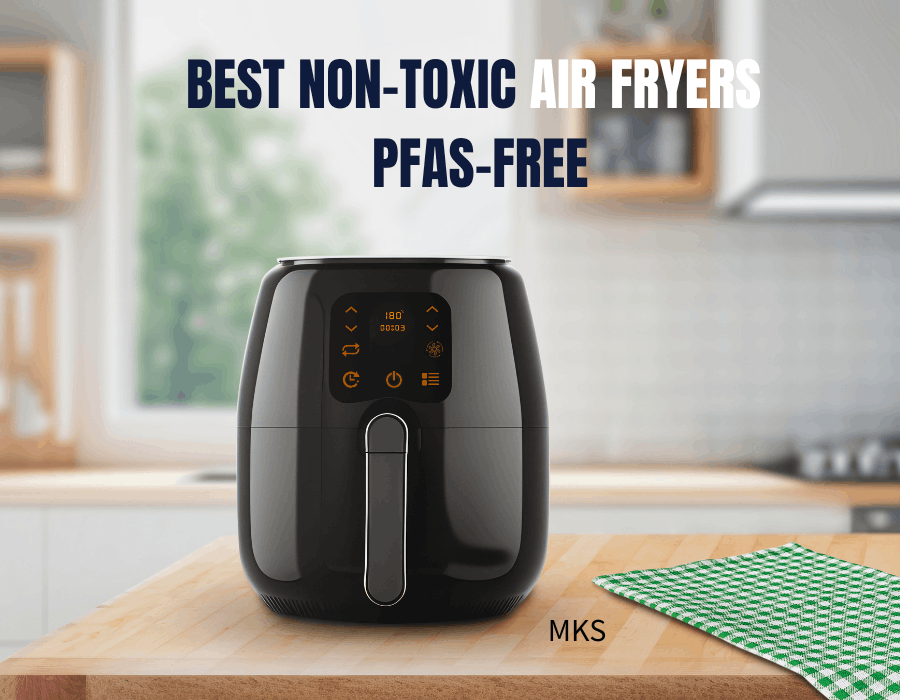
When I first saw an air fryer at a friend’s house, I was sold almost instantly.
The convenience was hard to ignore. There was no waiting for the oven to preheat, no figuring out which cooking setting to use, and no blast of heat every time you opened the oven door. Best of all, it was so easy to use that even the kids could help make their own snacks.
I remember thinking, “We have to get one.”
So we did.
And honestly? It quickly became one of the most-used appliances in our kitchen. My kids became so much more independent, it cooked food faster than the oven, and cleanup was a breeze. For years, I never questioned it.
That changed when I started researching non-stick cookware, PFAS, and whether there was such a thing as a non-toxic air fryer.
Completely by accident, I discovered that many air fryer baskets use the same type of non-stick coating found on traditional non-stick pans.
My first reaction was, “Wait… what?!”
I immediately started searching for the best non-toxic air fryer, but I quickly realized the answer wasn’t as straightforward as I expected.
That doesn’t mean every air fryer is unsafe or that you need to throw yours away today. But it does raise an important question.
Disclaimer: This post is based on personal experience and research. Some links may be affiliate links, meaning I may earn a small commission at no extra cost to you.
As an Amazon Associate, we earn from qualifying purchases.
If I wanted a non-toxic air fryer, what should I actually be looking for?
That’s the question I set out to answer. In this guide, I’ll share what I learned, what the research says, which air fryer materials are considered safer, and what to look for if you’re searching for a non-toxic air fryer.
What Does the Research Actually Say?
Before we talk brands, let’s be clear about what independent science has and hasn’t established because this matters.
What peer-reviewed research has confirmed:
A 2024 study published in Science of the Total Environment confirmed that PTFE-coated cookware emits gaseous PFAS compounds when heated, and that the coating degrades at high temperatures releasing airborne PTFE nanoparticles. Air fryers operate at exactly the temperatures where this degradation occurs.
The same research confirmed that physical damage to PTFE coatings aka non-stick coating scratches from utensils or normal wear accelerates chemical release into food.
The NIH’s National Institute of Environmental Health Sciences (NIEHS) has identified multiple health effects associated with PFAS exposure, including increased cancer risk, liver damage, immune suppression in children, and reproductive harm.
The CDC found PFAS in the blood of 97% of Americans tested. This is not a fringe concern, it is near-universal exposure.
What Makes an Air Fryer a PFAS Concern?
The issue isn’t the air fryer itself. It’s the coating on the basket and interior surfaces.
Traditional air fryer baskets are coated with PTFE to make them non-stick. At sustained high heat, exactly the conditions air fryers create, peer-reviewed research confirms PTFE coatings can degrade and release compounds. When baskets get scratched from food, tongs, or cleaning, that degradation accelerates.
Air fryers are particularly concerning for three reasons:
- They operate at sustained high heat. The exact conditions that degrade PTFE fastest
- The basket gets scratched constantly from normal use
- Most families use them multiple times a week, meaning exposure accumulates
And here’s the marketing reality: a “PFAS-free” label on the box doesn’t automatically mean every surface inside is safe.
Some brands describe the appliance as PFAS-free while accessories baking trays, racks, drip pans still have coated surfaces.
Always check what every food-contact surface is made of.
But what do PFOA-Free, PTFE-Free, and PFAS-Free actually mean?”
The Three Safest Air Fryer Materials
Stainless Steel No coating, no PFAS, nothing to scratch or degrade. The EPA lists stainless steel as a safe cookware material with no PFAS concerns. Requires a light spray of oil to prevent sticking but is the safest food-contact surface in any air fryer.
Tempered Glass Completely inert at high temperatures. No chemicals, no coatings, nothing to worry about. Glass bowl air fryers are a newer format but the clearest option for anyone who wants zero coating concerns.
Verified PFAS-Free Ceramic Its a genuine middle ground, non-stick without PFAS. When the brand explicitly confirms the coating is PFAS-free, PTFE-free, and PFOA-free with specific certification details then go for it. Vague terms like “eco-friendly coating” or “green non-stick” are not enough.
Non-Toxic Air Fryer Brands Worth Considering
Important disclaimer before this section: The following recommendations are based on manufacturer material disclosures, certification claims, and publicly available product documentation and not from independent government or peer-reviewed laboratory testing of these specific products.
Formulations can change. Always verify current specifications directly with the brand before purchasing, and check whether the brand provides third-party certification data to support their claims.
Typhur Sync – Most Transparent on Materials
Basket material: PFAS-free ceramic
What the brand discloses: FDA-certified ceramic coating, explicitly PFAS-free, PTFE-free, PFOA-free, lead-free, cadmium-free, titanium dioxide-free
Typhur stands out not just for what they claim, but for how specifically they document it. They name certifications, disclose what the coating is free of, and have responded clearly to consumer material inquiries.
That level of transparency is rare in this category. That’s why this brand consistently appears in credible non-toxic kitchen discussions.
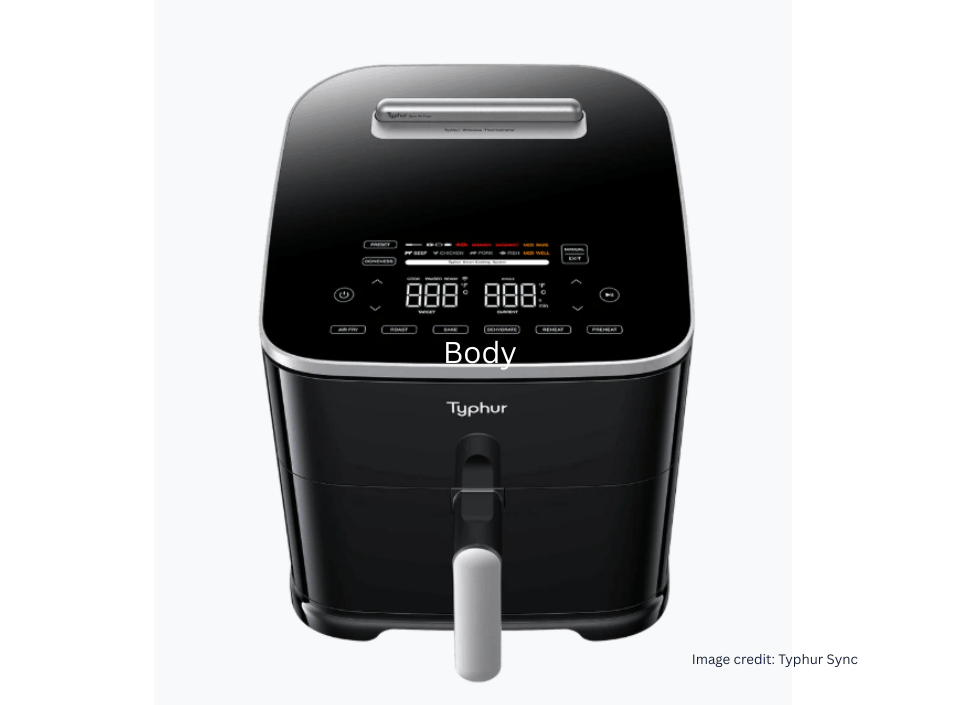
Worth knowing: Dual heating elements and a built-in meat thermometer make it a strong everyday performer as well.
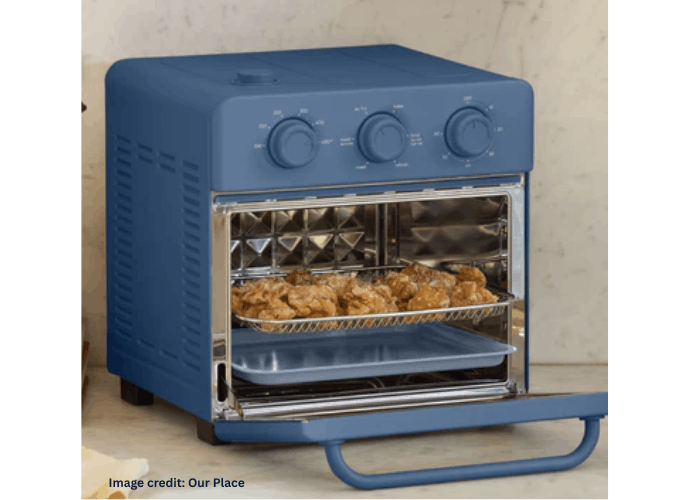
Our Place Wonder Oven – Stainless Steel Interior
Interior material: Stainless steel food-contact surfaces
What the brand discloses: PFAS-free, PTFE-free, lead-free, cadmium-free on primary food-contact surfaces
Our Place has built a consistent track record in the non-toxic kitchen space. The Wonder Oven’s cooking cavity is stainless steel, a material with no PFAS concerns regardless of heat or wear.
Fritaire Glass Bowl – Zero Coating Concerns
Interior material: Tempered glass bowl, stainless steel accessories
What the brand discloses: No PFAS, PFOA, PTFE, or BPA on any food contact surface. Proactively discloses that one small internal component uses food-grade PPS plastic rated well above its operating temperature.
The Fritaire removes the coating question entirely by using glass. There is no coating on any food-contact surface. The proactive disclosure about a minor non-food-contact plastic component is the kind of transparency that builds trust.
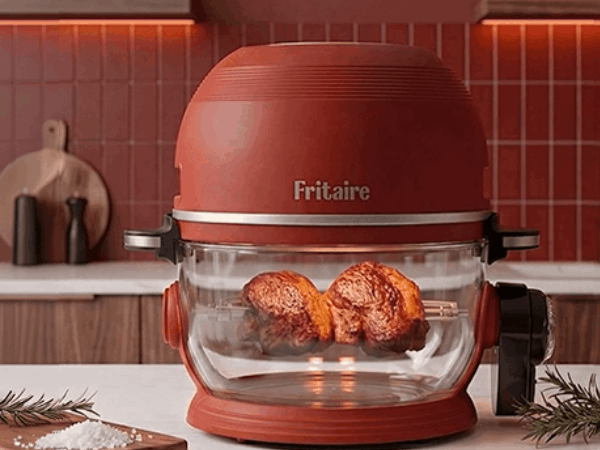
Worth knowing: The tumbler-style design rotates food as it cooks for even results without shaking.
Ninja Crispi – Compact Glass Option
Interior material: Glass containers
What the brand discloses: Food-contact glass surfaces positioned as PFAS-free and PTFE-free
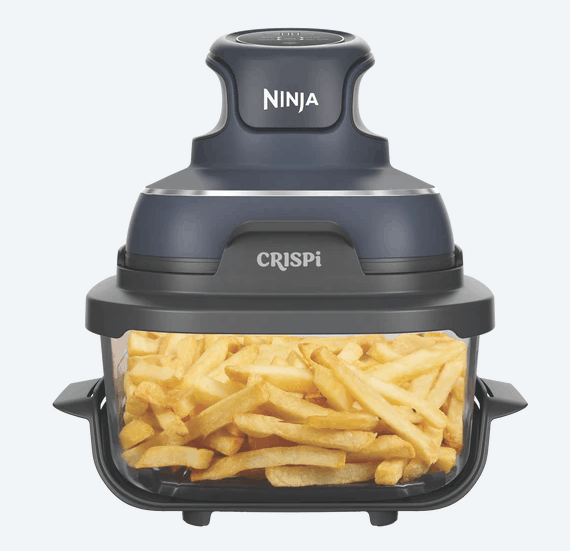
The glass container approach eliminates the primary PFAS concern. One caveat worth investigating: some reviewers have noted the base heat plate has an undisclosed coating material. Worth contacting Ninja directly to confirm before purchasing if complete coating avoidance is your goal.
Cosori TurboBlaze – Most Accessible Price Point
Basket material: PFAS-free ceramic
What the brand discloses: Explicitly PFAS-free, PFOA-free, PTFE-free, lead-free, cadmium-free
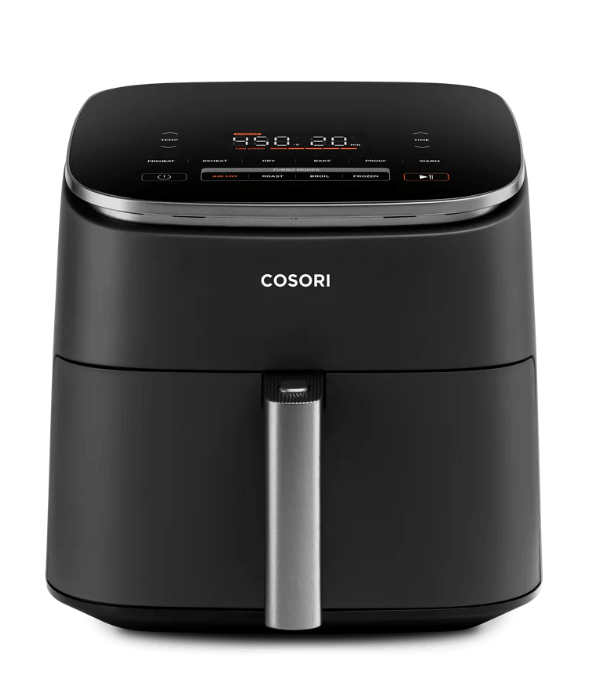
A strong combination of safety claims and everyday performance at a more accessible price. As with all ceramic-coated options, keep heat below 400°F, use silicone or wooden utensils, and hand wash to extend the coating’s life.
Brands to Approach With Caution
Any brand that only says “PFOA-free” As established by the Ecology Center’s independent testing PFOA-free without PTFE-free and PFAS-free means very little. If a brand only ticks one of the three boxes, keep looking.
Budget air fryers with unspecified coatings Any air fryer that doesn’t clearly disclose what its basket and interior surfaces are made of should be treated with caution. Cheaper models often use lower-quality coatings that degrade faster.
What to Look for When Buying
Run through this checklist before any air fryer purchase:
- Does the brand explicitly state PFAS-free, PTFE-free, AND PFOA-free?
- Does that claim cover every food-contact surface like basket, tray, and interior?
- Does the brand provide certification details or third-party test data?
- Are the accessories also PFAS-free or just the basket?
- Can you verify the claim by contacting the company directly?
If a brand can’t answer those questions clearly, that’s your answer.
What to Do With Your Current Air Fryer
If you already own a standard non-stick air fryer, a few habits reduce exposure while you plan a replacement:
Keep temperatures below 400°F. PTFE coatings degrade fastest at high heat. Most air frying works at 375°F or lower.
Never preheat an empty basket. An empty basket on high heat is the fastest way to degrade any coating.
Inspect the basket regularly. Any scratching, flaking, discolouration, or peeling means it’s time to replace.
Use silicone or wooden utensils only. Metal utensils scratch coatings and accelerate the problem.
So, what about me?
I’m planning to replace ours with either the Typhur Sync, Our Place Wonder Oven (if budget permits) otherwise the Ninja Crispi. At the moment, I’m leaning towards the Ninja because I love that you can actually see what’s cooking through the glass container.
The only thing I’m a little nervous about? I really don’t want my shiny new Ninja Crispi landing flat on my kitchen floor thanks to a pair of slippery little hands!
The Bottom Line
Research shows that the PTFE coating used on many traditional air fryer baskets can break down over time, especially when it’s exposed to high heat or becomes scratched. That’s why many people are choosing to reduce their exposure to these coatings where they can.
Thankfully, there are safer options. Stainless steel and glass don’t rely on non-stick coatings, while well-documented PFAS-free ceramic can be a good alternative when brands are transparent about the materials they use.
For me, it’s not about replacing everything overnight. It’s about looking beyond the marketing, asking what your food is actually touching, and making informed choices – one swap at a time.
Want to understand what those labels actually mean before you buy? Read this next: [How to Tell If Your Pans Have PFAS – 5 Signs to Check Right Now]
Sources
Health and scientific claims in this post are drawn from government agencies, regulatory bodies, and peer-reviewed research. Brand information reflects publicly available manufacturer disclosures only.
Breast Cancer Prevention Partners : PFAS cookware science review https://www.bcpp.org/pfas-in-cookware-cooking-the-science/
ScienceDirect – 2024 peer-reviewed study :PTFE coatings emit gaseous PFAS when heated, degrade under damage https://www.sciencedirect.com/science/article/pii/S0048969724027232
NIH PubMed — 2025 peer-reviewed review — PFAS health effects https://pmc.ncbi.nlm.nih.gov/articles/PMC12298592/
Ecology Center — Independent lab testing of non-stick pans https://www.ecocenter.org/our-work/healthy-stuff-lab/reports/whats-cooking/undisclosed-pfas-coatings-common
I’m shopping for an air fryer, and I had no idea about all these factors that I should consider. Thanks for the information. I won’t buy solely on aesthetics and ratings.