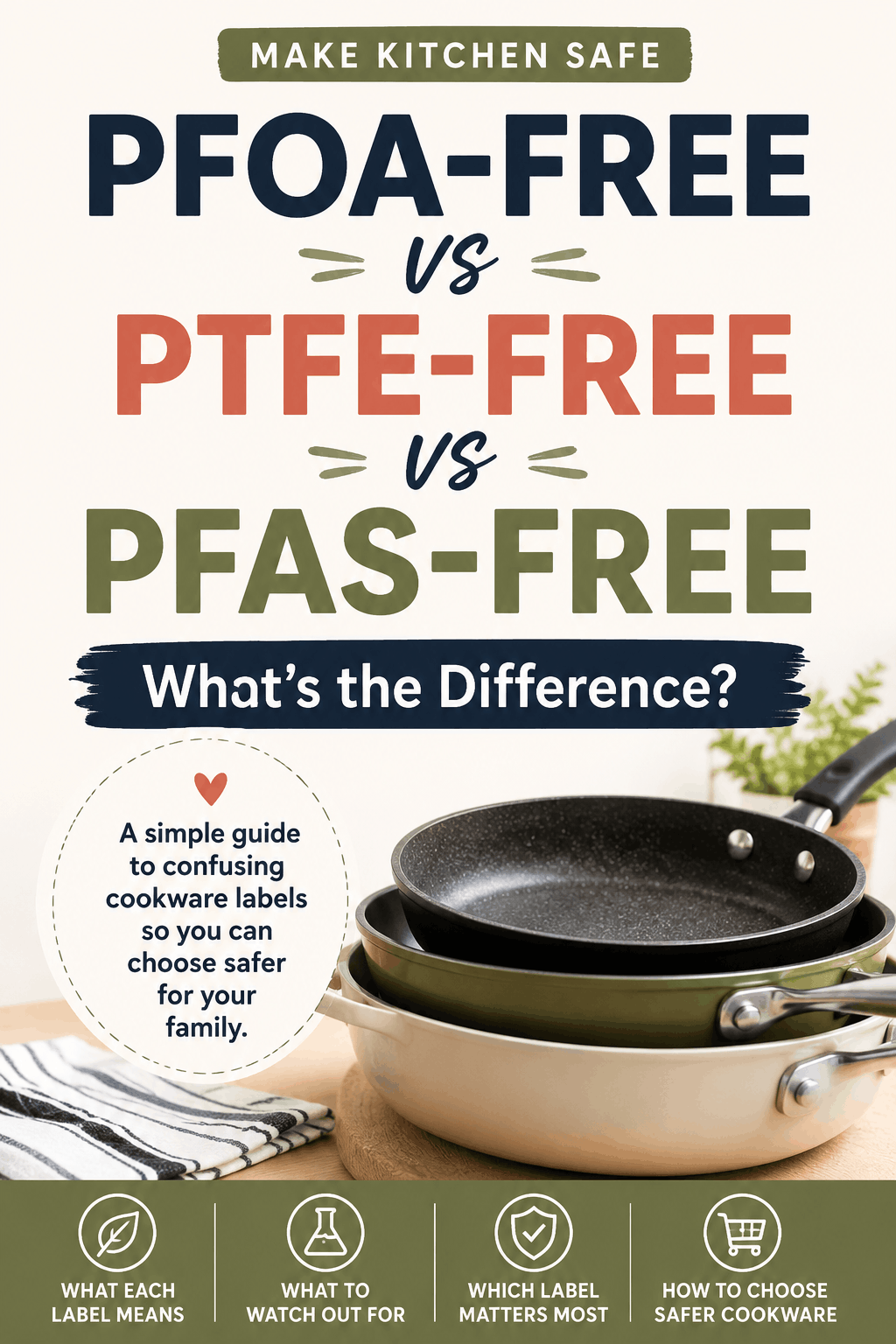
Have you ever picked up a frying pan and wondered…
Why does this one say PFOA-free, another says PTFE-free, and another says PFAS-free?
Honestly, it’s enough to make your head spin.
I remember thinking they all meant the same thing until I started digging into the research.
So today, let’s clear up the confusion once and for all. What exactly are PFAA, PFOA and PTFE free cookware?
How to Read PFOA and PTFE Free Cookware Labels
Before getting into definitions, here’s the simplest way to understand the relationship between these three terms.
Imagine three circles, sitting inside one another.
The biggest circle is PFAS. This is the huge family of more than 10,000 chemicals.
Inside that sits PTFE – the slippery coating used on many non-stick pans.
Inside PTFE sits PFOA, one chemical that used to be used when making PTFE.
Once you picture it like this, the labels become much easier to understand.
PFOA-Free – The Least Meaningful Label
What it means: The product was manufactured without using PFOA (perfluorooctanoic acid). Don’t worry you don’t need to memorize chemical names.
What it doesn’t mean: The product is free of PTFE, free of PFAS, or free of any other forever chemical.
PFOA was a processing chemical used during the manufacture of PTFE non-stick coatings. It wasn’t in the final coating itself. It was used in the production process to create the PTFE emulsion.
Over time, researchers linked PFOA to a number of serious health concerns, including certain cancers, thyroid disease, liver damage and reproductive problems. Because of this, manufacturers stopped using it during production in many countries.
So “PFOA-free” is now essentially universal on US-made cookware. Every major brand’s non-stick pan is technically PFOA-free. The label has become a marketing statement more than a meaningful safety claim.
Here’s the important part: removing PFOA from the manufacturing process did not remove the PTFE coating from the pan. The coating you cook on every day is still PTFE. PTFE is still a PFAS. The label “PFOA-free” tells you nothing about whether the coating itself is safe.
Consumer Reports made this point definitively when they tested a Swiss Diamond pan that was prominently labelled PFOA-free and found measurable amounts of PFOA in the coating anyway, plus 639 parts per billion of combined PFAS.
PFOA-free on the label did not mean PFOA-free in the pan.
PTFE-Free : A Meaningfully Stronger Claim
What it means: What it means: The product contains no polytetrafluoroethylene (PTFE). Don’t let the long name scare you! It simply means the pan doesn’t have the traditional Teflon-style non-stick coating that many people are trying to avoid.
What it doesn’t mean: The product is necessarily free of all PFAS compounds, though it likely is, since PTFE is the primary PFAS concern in cookware.
PTFE is the actual non-stick coating on the surface of the pan. It’s the slippery coating that stops your eggs from sticking and makes cleaning up so easy.
If you’ve ever accidentally left an empty pan heating on the stove, this is why PTFE matters.
If a PTFE-coated pan gets too hot, it can start to break down and release toxic fumes. Over time, if the coating becomes scratched or starts peeling, tiny particles can also end up in your food. That’s why many people are choosing to avoid PTFE altogether.
This is also why a PTFE-free label is much more meaningful than a PFOA-free label.
If you’re looking for a non-stick option without PTFE, ceramic-coated cookware is the most common choice. Most ceramic coatings are made from silica, a mineral-based material, rather than synthetic fluoropolymers. When properly certified, they’re free from both PTFE and PFAS.
One last thing before you start shopping. A PTFE-free label doesn’t automatically mean a product is PFAS-free. Some manufacturers may avoid PTFE but still use other PFAS chemicals in their coating. And that’s exactly why the next label – PFAS-free is just as important.
PFAS-Free: The Strongest Label to Look For
What it means: The product contains no PFAS (per- and polyfluoroalkyl substances)—the entire family of more than 10,000 forever chemicals, including PFOA, PTFE, PFOS, GenX and thousands of others.
What it doesn’t mean: That the claim has been independently verified. At the moment, “PFAS-free” isn’t a regulated label, so manufacturers can use it without proving it—unless they provide third-party testing or certification.
This is the strongest claim because it covers the entire PFAS family, not just one chemical. If a product is genuinely PFAS-free, it can’t contain PTFE or PFOA because both belong to the PFAS family.
If you come across cookware labelled PFOA-free, PTFE-free and PFAS-free, that’s an excellent sign—although it’s still surprisingly rare.
One last tip from me: don’t stop at the label. Look for brands that back up their claims with third-party testing, recognized certifications (such as FDA, LFGB or NSF), or a California AB1200 disclosure.
Anyone can print a label. Good brands can prove it.
The GenX Problem : Why “PFOA-Free” Isn’t the End of the Story
When PFOA was phased out, some manufacturers replaced it with a newer chemical called GenX, a shorter-chain PFAS compound. Early research from multiple universities has found that GenX may cause similar harm to the liver and kidneys as the chemical it replaced.
GenX is not PFOA. So a product can be PFOA-free and still contain GenX.
GenX is not PTFE either. It’s a separate PFAS compound used in manufacturing processes.
Only a PFAS-free claim covering the entire chemical family would rule out GenX and its chemical relatives along with PFOA and PTFE.
The Label Decoder – At a Glance
Here’s the practical summary of what each label rules out and what it doesn’t:
PFOA-free:
- Rules out: PFOA (one specific chemical, already removed from US manufacturing)
- Doesn’t rule out: PTFE, GenX, or any other PFAS compounds
- How meaningful: Low — essentially universal on US cookware now
PTFE-free:
- Rules out: PTFE (the Teflon-style coating itself)
- Doesn’t rule out: Other PFAS compounds used in manufacturing or coating chemistry
- How meaningful: High — directly addresses what’s touching your food
PFAS-free:
- Rules out: The entire family of over 10,000 forever chemicals
- Doesn’t rule out: Poor quality control or misleading claims without verification
- How meaningful: Highest — but requires evidence, not just the label
All three together (PFAS-free + PTFE-free + PFOA-free):
- The combination that carries the most weight
- Still requires verification- look for third-party testing or AB1200 disclosures
How to Choose PFOA and PTFE Free Cookware
So, what does all of this mean when you’re standing in the cookware aisle?
If you’re shopping for PFOA and PTFE free cookware, don’t let the biggest label on the box make the decision for you.
A pan that only says PFOA-free isn’t necessarily free from PTFE or other PFAS chemicals. Instead, look for cookware that’s labelled PTFE-free and PFAS-free, as these claims give you a much clearer picture of what’s actually touching your food.
Just as importantly, choose brands that are willing to back up those claims. Third-party testing, recognised certifications or California AB1200 disclosures show a company has done more than just print reassuring words on the packaging.
Or…you can skip the label-reading altogether.
That’s exactly what I did.
After months of researching cookware, I realized I didn’t want to spend ages decoding labels every time I bought a pan. And honestly? I’m not spending $250 on a single frying pan. I’m no Martha Stewart!
Instead, I switched to stainless steel, cast iron, carbon steel and enamelled cast iron. They don’t rely on synthetic non-stick coatings, so there’s no PTFE coating to worry about and no PFAS labels to decode.
Sometimes, the simplest option really is the easiest.
The Bottom Line
The next time you’re shopping for PFOA and PTFE free cookware, remember this:
- PFOA-free only tells you one chemical wasn’t used during manufacturing.
- PTFE-free tells you the traditional Teflon-style coating isn’t on the pan.
- PFAS-free is the broadest claim because it covers the entire family of forever chemicals but it’s always worth checking whether the brand provides evidence to support it.
At the end of the day, labels are there to help you make informed choices not confuse you.
My advice? Buy from brands that are transparent, ask questions when something doesn’t seem clear, and don’t feel pressured to replace everything overnight. Even swapping one pan at a time is a step towards creating a kitchen you feel good about.
Want to know how to check whether your current pans already contain PFAS? Read this next:How to tell if your pans have PFAS — 5 signs to check right now
PFOA-Free Nonstick Cookware: What to Actually Look For
Sources
All claims in this post are drawn from independent testing, peer-reviewed research, government agencies, and regulatory bodies.
- Consumer Reports — independent testing — PFOA-free labelled pan found to contain 639 ppb combined PFAS; recommends focusing on PTFE-free claims over PFOA-free https://www.consumerreports.org/toxic-chemicals-substances/you-cant-always-trust-claims-on-non-toxic-cookware-a4849321487/
- US EPA — PFOA Stewardship Program — voluntary industry phase-out of PFOA by 2015 https://www.epa.gov/assessing-and-managing-chemicals-under-tsca/fact-sheet-20102015-pfoa-stewardship-program
- US EPA — PFAS health risks https://www.epa.gov/pfas/our-current-understanding-human-health-and-environmental-risks-pfas
- NIH — NIEHS — PFAS health effects https://www.niehs.nih.gov/health/topics/agents/pfc
- Ecology Center — Dr Gillian Z Miller, Senior Scientist — PTFE-free claim is more meaningful than PFOA-free on non-stick cookware; ceramic pans with PTFE-free claims far less likely to contain forever chemicals Referenced via Consumer Reports
- California AB1200 — Safer Food Packaging and Cookware Act — bans single-chemical PFAS-free claims (e.g. PFOA-free only) on cookware sold in California from 2023 https://leginfo.legislature.ca.gov/faces/billNavClient.xhtml?bill_id=202120220AB1200
- ScienceDirect — 2024 peer-reviewed study — PTFE coatings emit gaseous PFAS when heated https://www.sciencedirect.com/science/article/pii/S0048969724027232
- NRDC analysis of EPA findings: https://pmc.ncbi.nlm.nih.gov/articles/PMC12389976/

[…] If you’re still seeing labels like “PFOA-free,” “PTFE-free” or “PFAS-free” on cookware and wondering whether they all mean the same thing, they don’t. I explain the differences here: PFOA-Free vs PTFE-Free vs PFAS-Free: What’s the Difference? […]
[…] PFOA-Free vs PTFE-Free vs PFAS-Free: What’s the Difference? […]